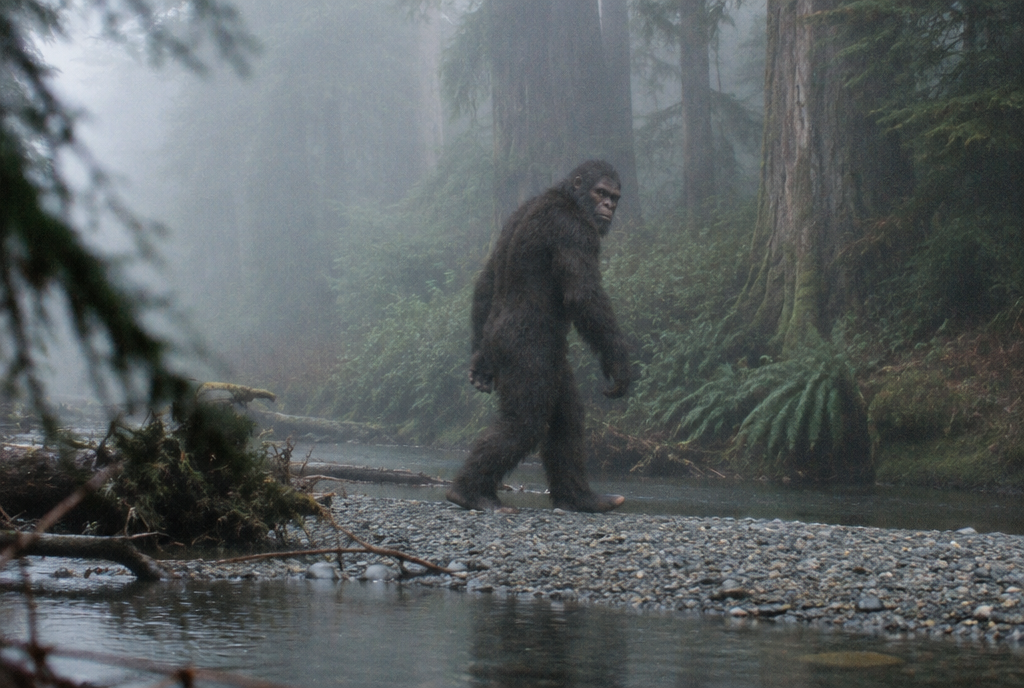
Fifty-nine seconds at Bluff Creek
On 20 October 1967, Roger Patterson and Bob Gimlin rode on horseback into the Bluff Creek drainage in northern California, a place already famous for giant footprints, and came out with the most contested minute of film ever shot. Patterson’s rented 16mm Kodak camera caught a dark, heavy-shouldered figure walking across a sandbar, swinging its arms, and turning once to look at the men before it disappeared into the trees.
Frame 352 — the look back — became the image everyone knows. For believers it is the moment a living animal acknowledged a camera: the roll of the shoulder, the flex of a thigh under the hair, a stride that long-limbed humans struggle to copy without looking ridiculous. For sceptics it is a man in a suit on an afternoon when nobody was going to check, a verdict strengthened in 2004 when costume-maker Philip Morris said he sold Patterson the gorilla suit and a Yakima man named Bob Heironimus said he wore it.
What makes the film endure is not that it has been proven, but that it has never quite been disproven in the way a hoax usually is. Nobody has produced the suit. Stabilised versions of the footage show movement that costume analysts still argue about. And Gimlin, who outlived everyone else involved, never changed his story in more than five decades of being asked.
Science has moved on without a verdict. No body, no bones, no verified DNA — every hair sample tested in the 2014 Oxford–Lausanne survey turned out to be bear, horse, cow, or human. But the footprints keep appearing in the mud, the sightings keep getting logged, and every autumn somewhere in the Pacific Northwest a camera is lifted toward a shape at the treeline, just in case.